Apple Baking Season Is Here: Which Apples Are Best for Baking? We Put Six to the Test.
We’re often asked how to cook with Michigan Apples and which apples are best for baking. Baking with apples can be a great way to explore and discover new varieties during harvest season because each variety has its own baking personality and sweet vs. tart apple flavor profile. In this guide, you’ll discover why your pie filling might have turned mushy and learn how to confidently select apples for pie, crisps, tarts, muffins, and more!
The Science of Baking with Apples
When it comes to baking, comparing apples to apples isn’t as simple as it sounds. Finding the best baking apple is a mix of science, personal preference, and a little magic. Some people prefer tart, crunchy apple chunks, while others like a sweet, melt-in-your-mouth experience.
Why does apple pie turn mushy? A lot of how an apple behaves during cooking is dependent on its pectin, acidity levels and density (air spaces between cells). Pectin acts as the glue that holds apple cells together, providing strength and structure. Apples that hold their shape (like sautéed apple slices that refuse to break down for applesauce) are usually apples that have strong pectin. Acid (think tart-tasting apples) strengthens that pectin, generally further slowing breakdown during cooking. That’s why some apples hold their shape in your pie, while softer apples with weaker pectin can leave you with smooth applesauce.
Choosing an apple is less about “good” or “bad” and more about picking one that behaves the way you want.
The Great Michigan Apple Bake-Off
Apple baking science gives us helpful clues, but apples don’t always follow the rules! We put six common Michigan Apple varieties to the test in a 350°F oven to see which held their shape and which softened into spoonable goodness.
Ginger Gold, Golden Delicious & Honeycrisp: In our experiment, the Ginger Gold broke down to mush almost immediately, followed closely by Golden Delicious, with Honeycrisp taking a bit longer. These apple varieties would be great for applesauce, apple butter, or muffins where you don’t want any crunch.
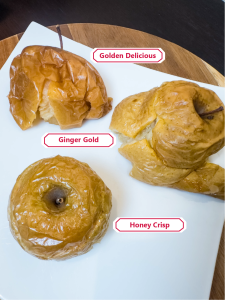
However, as you can tell from the photo, Honeycrisp does hold its shape well and will take a little more patience to turn into applesauce.
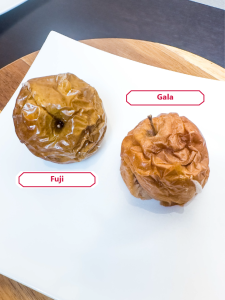
Fuji & Gala: Fuji and Gala were neck and neck, but Gala started breaking down first, resulting in a softer texture. This isn’t a surprise because Fuji is denser than Gala. A simple test to try at home to detect which apple is denser: the bite test! Firm bites come from denser apples that generally hold their shape better while cooking. In our comparison, Fuji had a firmer bite, while Gala had a softer bite and broke down more quickly.
Flavor Tip: Sweet apples, like Honeycrisp and Fuji, are great for a sweet-tasting applesauce or smoothie. Add these varieties anywhere you want a little extra sweetness.

Cripps Pink (aka, Pink Lady): And finally, Cripps Pink! It held its shape almost entirely in our test. Cripps Pink is one of the tartest Michigan Apple varieties available, which partially explains why it kept its shape so well, making it a great variety for baked apples or pies with distinct apple slices and an ‘al dente’ bite. While Honeycrisp softened more readily in our test, it’s also a great one to try for a firmer baking apple.

So…What are the best apples for apple pie
Golden Delicious’s sweet flavor and tender texture make it a great choice if you love a softer filling. For a little more bite, try pairing it with a firmer variety, like Fuji, Cripps Pink, or Honeycrisp. It all comes down to the texture you love!
Your Michigan Apple Baking Summary Cheat Sheet
Now you know your Michigan Apples. Let’s get baking! Use our bake-off results to choose the right Michigan Apple, with the flavor and texture you love, for your next autumn baking adventure.
Michigan Apple Variety | Baking Behavior & Best Uses | Michigan Apple Recipe Ideas |
Golden Delicious Gala Ginger Gold | Sweeter apples that soften quickly. These apples softened and broke down in our experiment. Best for tender fillings, applesauce, or when you want apples to blend into your recipe. | |
Honeycrisp Fuji | Sweeter apples that hold their shape. These apples (mostly) held their shape in our experiment. Best for tender but distinct apple slices or pieces with sweeter flavor. | |
Cripps Pink (aka, Pink Lady) | Tart-leaning apple that hold its shape. Holds shape strongly. Best for defined apple pieces and some tartness to balance sweet desserts. |
Mix if up: Choosing the best apples for apple crisp or pie? You don’t have to choose just one variety. Pair sweet and tart apples to balance flavor, or combine soft and firm apples for a mix of textures. Try it in this Skillet Apple-Cherry Pie.
Choosing the right baking apple still involves a little magic.
Acidity and pectin can help apples hold their shape, but they’re only part of the story. Cell structure, ripeness, and storage matter, too. Some tart varieties, like McIntosh and Paula Red, cook down beautifully into soft fillings and sauces, so the science and our bake-off experiment don’t always hold true across all Michigan Apple varieties.
Yes, Michigan Apples have got some major personality! But this bake-off gives you a starting place, so you can head from the grocery store to the oven with confidence.